Start With the Proof, Not the Names
The names will get the attention. The numbers deserve it. Salesforce reports that Agentforce and Slack have together delivered 7 billion Agentic Work Units, with 3.2 billion in Q2 2026 alone — a measure of agent actions completed, not demos shown.
More useful for buyers are the early customer results attached to each agent:
of Engine's chat inquiries are fully resolved by its help agent, Eva
of Perk's sales pipeline is built by its outbound sales agent, Hunter
of Autism Queensland's administrative requests are resolved by its employee service agent, Paige
of core shopper journeys handled by Hibbett's AI agent — live in six weeks
conversation volume driven by Asana's website agent, Piper — deployed in 45 days on average
of Anthropic's conversations seen by Fin are resolved autonomously
These figures are reported by Salesforce and its customers; as with any vendor-reported metric, treat them as directional and validate against your own volumes in a pilot.
Why Giving Agents Names and Jobs Matters
Until now, most enterprise AI has been sold as a platform: assemble your own agents from skills, prompts and flows. This announcement flips the model. Salesforce is now selling staff, scoped to a job title — an agent for service resolution, an agent for inbound qualification, an agent for supply-chain orchestration — each pre-built with the skills, actions and data models the job requires.
For customers, that changes the buying question from "what could we build?" to "which role do we fill first?" It shortens time-to-value, gives each deployment a measurable job description, and makes accountability clearer: an agent with a defined job can be measured against one.
Each agent can be tailored to the business — including taking the company's own name — and operates inside existing business rules, permissions and security rather than beside them.
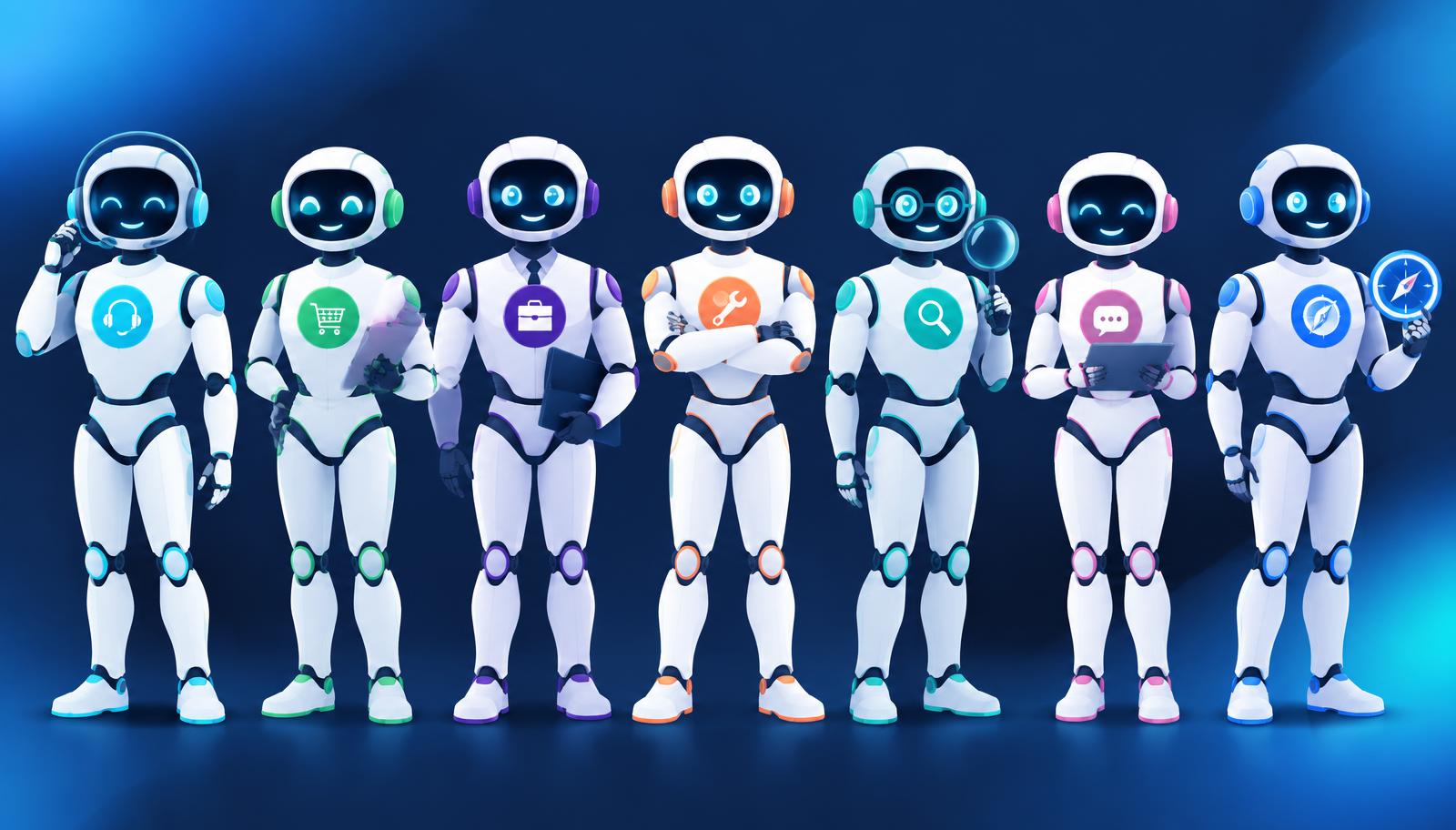
Meet the Seven
Six agents are generally available now. Hunter — the outbound sales agent — is in pilot, with general availability planned for November 2026.
Casey — Help agent — customer service
Resolves service issues across voice, SMS, WhatsApp and web chat, with pre-built handling for FAQs, returns, account management and escalation to a human.
Fin — Customer agent — complex CX workflows
Resolves complex customer-experience workflows across every channel, powered by the Operator agent and Fin Apex models trained for customer experience.
Carter — Shopper agent — commerce
Helps shoppers discover and compare products, get questions answered and convert with in-chat checkout.
Piper — Inbound pipeline agent — marketing & sales
Works across websites and inboxes to engage, qualify and convert inbound leads into pipeline for B2B sales and marketing teams.
Hunter — Outbound sales agent
Works a sales pipeline from research to outreach, collaborating with sellers over weeks and months — the first agent built on the new long-horizon runtime.
Paige — IT & HR service agent — workforce
Resolves employee requests across Slack, portals and the tools employees already use.
Marshall — Supply chain agent — back office
Orchestrates end-to-end back-office processes, automates manual work with deterministic execution and provides an audit record of every action.
The Deeper Story: Agents That Work for Weeks, Not Minutes
The most important part of this release is easy to miss. Outbound sales is not a task that finishes inside a conversation — winning an opportunity takes weeks of research, outreach, changing priorities and decisions. So Salesforce built a long-horizon runtime that lets an agent pursue a goal across days and weeks instead of ending when the chat window closes.
A seller could ask Hunter to rescue at-risk deals before quarter-end. The agent turns that into a measurable goal, builds a plan, and works toward it — deciding which tasks to run, which tools and context it needs, and where the guardrails require seller approval. Three capabilities make it possible:
Memory
Preserves context and progress across sessions, so work does not stop when the interaction ends.
Durable execution
Keeps plans running over time, resuming or course-correcting as circumstances change.
Dynamic steering
Adapts the agent's behaviour based on the individual user's feedback and direction.
Hunter is the first agent on this runtime. Salesforce says more agents will follow, and customers will be able to build long-horizon agents of their own with Agentforce.
The Platform Around the Agents
Multi-Agent Orchestration — GA now
Routes work across specialised agents so they operate as one coordinated team when a job crosses roles, systems or stages of the customer journey.
Agent Script
Salesforce's open-source language for agent behaviour — combining AI reasoning with deterministic rules for granular control over how agents decide and act.
AI Skills in Agentforce Coworker — GA October 2026
Employees teach Coworker how to complete a task once, then scale that know-how across the workforce and across interfaces. In pilot now.
Agent Optimizer — GA October 2026
Works alongside teams across the agent lifecycle — building and refining agents, subagents and actions, testing performance and analysing session traces for what to improve.
What This Means for Customers
Practical starting points by function — based on the announced capabilities and early customer results.
Service leaders: Casey or Fin for resolution at scale
Deflect routine volume across voice, SMS, WhatsApp and chat while keeping clean human escalation — Engine reports 50% of chat inquiries fully resolved.
Marketing & revenue teams: Piper for inbound qualification
Engage every inbound lead instantly instead of queuing for follow-up — Asana drives 4x conversation volume and deploys in 45 days on average.
Sales organisations: Hunter for outbound pipeline
An agent that researches, plans and works a pipeline over weeks with seller guardrails — Perk reports 60% of pipeline built by Hunter. Plan a pilot now for November GA.
Commerce businesses: Carter for the shopper journey
Guided discovery through in-chat checkout — Hibbett handles 90% of core shopper journeys and went live in six weeks.
IT & HR: Paige for employee service
Resolve repetitive internal requests where employees already work — Autism Queensland resolves 70% of administrative requests with Paige.
Operations & supply chain: Marshall for the back office
Deterministic execution with an audit record of every action — the detail enterprise risk and compliance teams will ask about first.
KVP View: Buy the Job, Govern the Goal
This is a staffing decision, not a software feature. Named, job-ready agents move the conversation from platform capability to workforce design: which roles to augment, what output each agent is accountable for, and how it is reviewed.
The long-horizon runtime is the real release. Memory, durable execution and dynamic steering are what separate an AI worker from an AI chatbot. Watch Hunter's November GA — it will validate whether weeks-long autonomous work holds up in production.
Proof beats promise, so pilot against your own numbers. The customer metrics are encouraging but vendor-reported. The right move is a bounded pilot with baseline volumes, a target metric and a clear human-escalation path.
Governance travels with the agent. These agents inherit your permissions and security — that is architecture, not marketing. Validate field-level access, audit trails and Agent Script guardrails before scale, exactly as you would for a new employee with system access.
How the Seven Agents Map to Industries
Manufacturing & distribution
Marshall for order and supply-chain orchestration; Piper to qualify distributor and dealer enquiries; Casey for after-sales service across WhatsApp and voice.
Retail & e-commerce
Carter for guided shopping and in-chat checkout; Casey for returns and order management; Paige for store and head-office employee support.
Financial services
Piper and Hunter for compliant pipeline generation with full audit trails; Fin for complex, policy-bound customer workflows — with access controls validated first.
Healthcare & life sciences
Paige for non-clinical staff and provider helpdesk requests; Casey for patient-service administration such as appointments, billing queries and account management.
Technology & SaaS
Hunter for outbound pipeline, Piper for inbound conversion, Fin for support deflection — the full revenue and service motion covered by three agents.
Hospitality & travel
Carter for booking assistance, Casey for guest service across channels, Paige for distributed frontline staff support.
A Practical Readiness Checklist
Pick one job with a measurable output
Resolution rate, qualified pipeline, conversion or request deflection — not 'AI adoption'.
Baseline your current volumes
You cannot validate a 50% or 79% claim without your own starting numbers.
Fix the data and permissions first
Agents inherit your Customer 360 context and access model — duplicates and loose permissions scale with the agent.
Define guardrails before go-live
Escalation paths, approval thresholds and audit review — using Agent Script where deterministic control is needed.
Availability and Pricing
Six of the seven agents are generally available now. Hunter is in pilot with general availability planned for November 2026. AI Skills in Agentforce Coworker and Agent Optimizer reach general availability in October 2026; Multi-Agent Orchestration is GA now. Salesforce has not publicly disclosed pricing for the agents or the supporting capabilities — confirm editions, regional availability and commercial terms with your Salesforce account team, and base purchase decisions on currently available features.