
What Was Announced at Dreamforce
On September 15, 2026, at Dreamforce in San Francisco, Siemens and Salesforce announced a new chapter in their partnership: combining Salesforce's autonomous AI platform Agentforce with Siemens Teamcenter Service Lifecycle Management (SLM). The goal is to help industrial companies become "agentic enterprises" at scale—putting engineering-grade answers directly into sales, service and customer workflows.
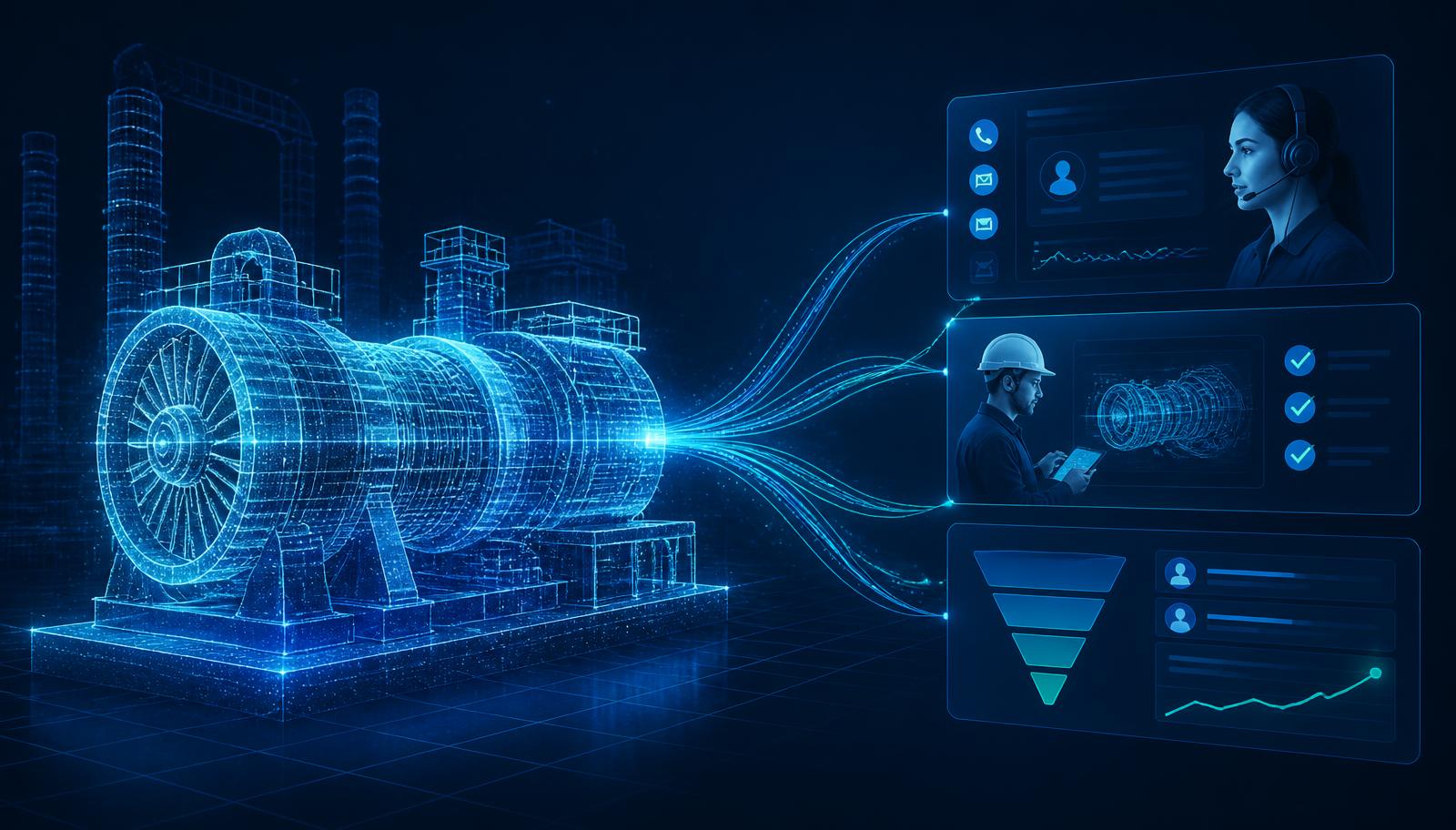
The core idea is an agent-to-agent connection between enterprise AI and industrial AI. Salesforce brings the customer workflow, data, business logic and governance; Siemens brings the digital twin—the authoritative, engineering-grade definition of how a product is designed, configured and serviced. Together, the companies describe the result as "a critical building block for an industrial AI operating system that connects engineering, operations and business."
"For decades, the expert knowledge of the engineer has been separate from the person servicing the machine in the field. We are closing that gap forever," said Roland Busch, President and CEO of Siemens AG. "By embedding our digital twin into the commercial workflow, we are putting a virtual engineer in the hands of every service technician and salesperson."
How Digital Twins Will Impact the Future of Work
The future-of-work story here is not about replacing people—it is about removing the waiting. Today, a large share of industrial front-office work is really just queuing: a seller waits for engineering to validate a configuration, a technician waits for a parts list, a customer waits on a hotline. When the digital twin is embedded in the workflow, that waiting disappears.
Three roles change first. The service technician arrives on site already knowing the right spare parts for the specific serial number. The sales representative quotes only upgrades that are technically valid and manufacturable—no more selling what engineering cannot build. And the customer finds and orders the right part without waiting for an engineer or calling a hotline.
Longer term, this lays the foundation for predictive, performance-based service models—where manufacturers sell uptime and outcomes, not just equipment. That is a structural change in how industrial companies organise work, price value and relate to customers.
Siemens Is Already Living the Pattern
This is not only a product announcement—Siemens has deployed Agentforce itself. The company was receiving over 2,500 unqualified leads a month with no way of knowing which deserved sellers' time. It turned to Agentforce to convert inbound interest into productive sales conversations for 18,000 sellers.
Leads flow into Sales Cloud, where two AI agents work in tandem: an engagement agent reaches out with personalised email (each message carrying a secure public key that identifies the lead without exposing internal record IDs), then hands interested prospects to a qualification agent that vets each one—capturing details like budget and timeline—before routing the strongest opportunities to the right seller.
The result: Siemens now engages 100% of its inbound leads across 132 countries. It is a reference architecture any manufacturer can study: agents handle the volume, humans handle the relationships.
How Customers Benefit
Service: the right part before the first visit
A service technician can identify the correct spare parts for a specific serial number before arriving on site—fewer repeat visits, faster resolution, better first-time-fix rates.
Sales: quote only what can be built
A sales representative can quote only those upgrades that are technically valid and manufacturable, reducing rework, credit notes and broken promises.
Customer self-service: no hotline queue
A customer can find and order the right part without waiting for an engineer or calling a hotline—industrial buying starts to feel like modern digital commerce.
Growth: aftermarket revenue at scale
The press release notes aftermarket business grows around six times faster and carries roughly four times the margin of new equipment sales. Digital-twin-grounded agents make that motion scalable.
Where This Helps by Industry
The announcement targets industrial companies first, but the pattern travels. These are KVP's view of where digital-twin-grounded agents create the most value.
Manufacturing and industrial equipment
Serial-number-specific service, valid upgrade quoting, spare-parts self-service and the foundation for predictive, performance-based service contracts.
Energy, infrastructure and mobility
Complex configured assets—turbines, grids, rail and building systems—where engineering truth must travel with the customer record through long asset lifecycles.
Any enterprise with a large field force
The Siemens pattern generalises: put governed product or asset knowledge into the workflow of every technician and seller, not just the experts.
KVP View: Product Truth Is the Missing Layer in Enterprise AI
Most enterprise AI answers are fluent but ungrounded. A general model can describe a turbine; it cannot tell you which spare part fits serial number 4711. Grounding agents in the digital twin changes AI from a helpful narrator into a reliable coworker—and reliability, not fluency, is what industrial work demands.
This is the agentic-enterprise blueprint made concrete. At Dreamforce we saw the interface layer (AIforce), the reasoning layer (Koa) and now the product-truth layer (Teamcenter). Industrial customers should read these announcements as one architecture, not three products.
Aftermarket is where the money is. When aftermarket grows ~6× faster than new equipment at ~4× the margin, every hour shaved off quoting and every first-time fix compounds. Manufacturers that connect product truth to customer context first will set the service expectations everyone else must meet.
Governance still decides success. A virtual engineer quoting invalid configurations at machine speed is worse than no agent at all. Scoped actions, serial-number-level data quality, human escalation paths and outcome monitoring remain the work—and they are exactly where an experienced implementation partner earns its keep.
Start where Siemens started. You do not need a full digital-twin integration on day one. The Siemens lead-engagement pattern—two governed agents engaging and qualifying 100% of inbound demand—is achievable now, and it funds the journey.
A Practical Readiness Checklist
Asset data quality
Are serial numbers, configurations and service history complete and accurate enough to ground an agent?
Workflow definition
Which sales and service decisions genuinely need engineering truth—and which need only policy checks?
Integration path
Where does your PLM or asset data live today, and what is the realistic route into the customer workflow?
Governance
Who approves agent actions, where do humans escalate, and how will you measure quote accuracy and first-time fix?