
Quick Answer
How does the tender agent help heavy engineering and construction businesses?
In heavy engineering and EPC, bidding is a high-stakes, capital-intensive exercise. Committing scarce estimation bandwidth and securing Earnest Money Deposits or bank guarantees on non-viable contracts burns hundreds of engineering hours and exposes the balance sheet to margin erosion. KVP's Government Tender Intelligence asset, powered by Salesforce Agentforce, automates the intake, extraction and feasibility vetting of massive public works and engineering tenders — pinpointing structural risks, delivery constraints and qualification thresholds before senior estimators spend days buried in BOQs, drawings and technical schedules.
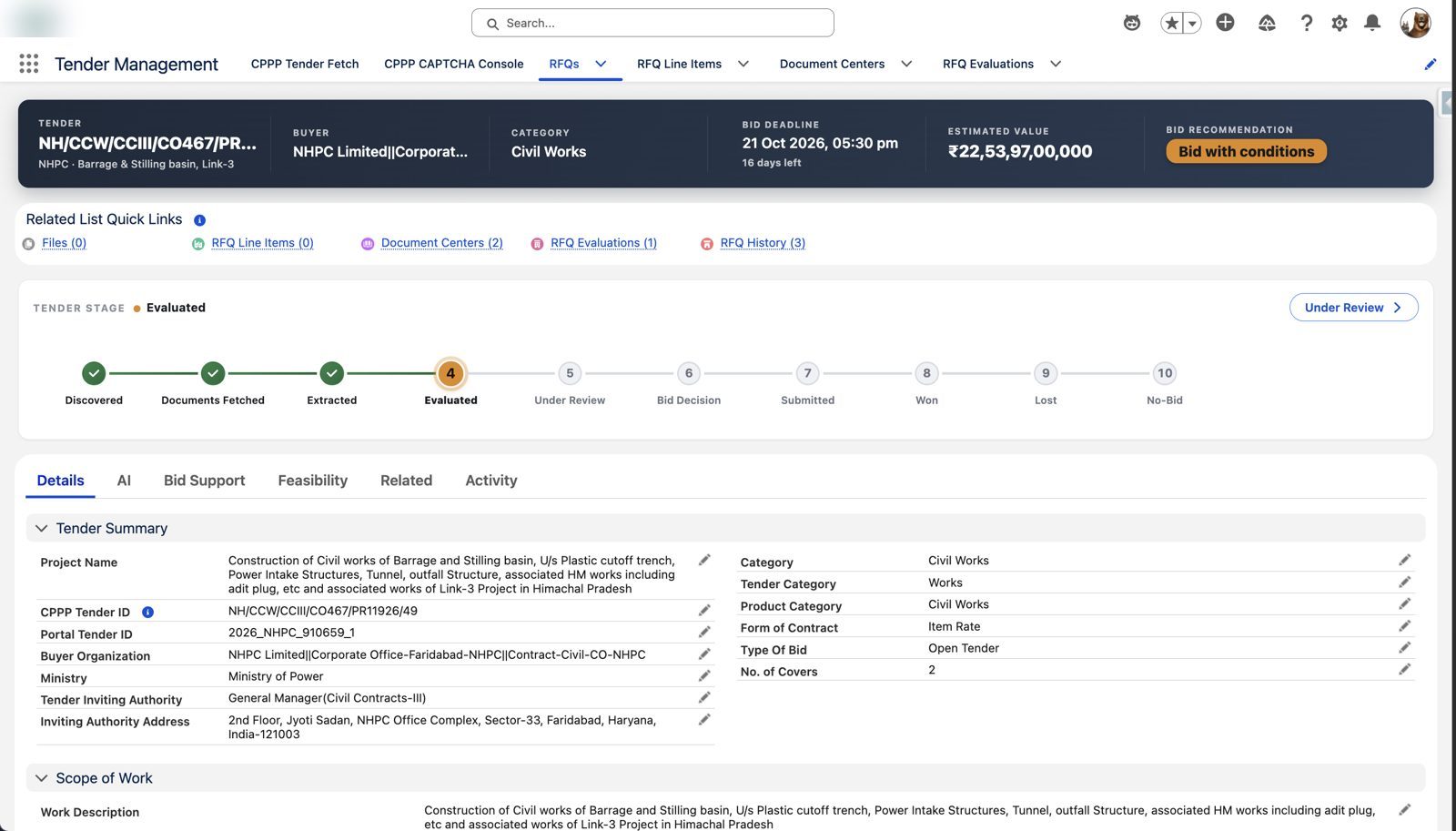
Capital and operational impact for EPC and heavy engineering
| Critical metric | Conventional EPC bid qualification | With Agentforce Tender Intelligence |
|---|---|---|
| Initial feasibility assessment | 5 to 7 days reading extensive General and Special Conditions of Contract (GCC/SCC) and BOQ annexures. | Document ingestion, risk extraction and executive feasibility scoring targeted in under 45 minutes of processing. |
| Senior estimation bandwidth | 35–45% lost vetting projects with unviable completion schedules, punitive liquidated damages or mismatched plant capacity. | Protected for high-margin wins, with early evidence-backed No-Bid gates on misaligned packages. |
| Cash and exposure governance | Risk of locking working capital or forfeiting bid security due to unspotted disqualification clauses. | Early visibility into EMD, bank guarantee commitments, price-variation formulas and mobilisation milestones. |
| Query and pre-bid preparedness | Rushed technical reviews miss pre-bid query deadlines, forcing teams to bid on ambiguous employer requirements. | Automated extraction of technical gaps and inconsistencies, generating draft buyer clarifications within 24 hours of notice publication. |
The right-hand column describes design targets from the asset's specification. Confirm actual timings and bandwidth effects with measured pilot data before quoting them externally.
Engineering-grade AI: built for heavy construction and industrial contracts
Defend pre-sales engineering and estimation capacity
Senior structural, civil and mechanical estimators should focus on rigorous cost-modeling, vendor negotiations and constructability analysis — not manual PDF searches. The agent evaluates public tenders against seven mission-critical feasibility pillars: technical and plant capability matched against your fleet and operational capacity; commercial exposure including harsh liquidated damages, negative cash-flow milestones, retention terms and one-sided indemnity clauses; and schedule and site constraints such as unrealistic defect liability periods, aggressive commissioning timelines and severe site access limitations.
Zero-hallucination governance: full clause traceability
In critical infrastructure projects, an unverified assumption can result in multi-crore contractual disputes. Every milestone, qualification threshold and performance security demand is mapped side by side with its exact page in the employer's tender documents. If the documents are silent on critical items — such as site handover schedules, soil data or price-escalation indices — the agent explicitly marks them as unconfirmed, preventing costly blind bids.
Integrated bid board and subcontractor packaging in Salesforce
A verified Bid recommendation immediately initiates your structured EPC proposal workflow: a pre-bid countdown tracker automates countdowns for site visits, employer query cut-offs and corrigenda releases; work-package orchestration parcels requirements into discrete Salesforce tasks for structural design, commercial finance, legal and contract vetting, and procurement teams; and corrigenda control instantly flags amendments released by the portal, ensuring your pricing model reflects the latest scope revisions.
KVP view: margin protection starts before the estimate
The cheapest bid to lose is the one you never pursued. Evidence-backed No-Bid gates on misaligned packages protect estimation capacity for winnable, high-margin work. The seven feasibility pillars make that gate defensible to leadership because every rating cites its source.
Treat EMD and bank guarantees as a governance question. Early visibility into bid security, price-variation formulas and mobilisation milestones lets finance assess working-capital exposure before commitment — not after a disqualification clause is spotted too late.
Keep humans on the submission. The asset does not submit bids automatically. Authorised people approve pricing, declarations and the final submission, following the portal's rules. Agentforce licensing and consumption costs are confirmed during scoping.
Where KVP can help: pilot the asset on representative EPC dossiers, configure the feasibility scoring to your plant and fleet, and set up the bid board and corrigenda control in your Salesforce org. See the full walkthrough on the asset page.
Frequently asked questions
How does the tender agent help EPC and heavy engineering bidders?
It automates intake, extraction and feasibility vetting of large public works and engineering tenders. Structural risks, delivery constraints and qualification thresholds are surfaced before senior estimators spend days in BOQs, drawings and technical schedules. The assessment is evidence-backed and traceable to the source pages.
Which commercial risks does it flag?
The agent flags harsh liquidated damages, negative cash-flow milestones, retention terms, one-sided indemnity clauses, EMD and bank guarantee commitments, price-variation formulas and mobilisation milestones — each cited to its exact page in the tender documents.
What are the seven feasibility pillars for engineering tenders?
They cover technical and plant capability, commercial exposure, schedule and site constraints, eligibility, execution risk and competitiveness. Equipment specs, testing standards and site execution parameters are matched against your fleet and operational capacity.
What happens when tender documents are silent on critical items?
The agent explicitly marks items such as site handover schedules, soil data or price-escalation indices as unconfirmed rather than assuming an answer, preventing costly blind bids and generating draft buyer clarifications.
Does it submit bids to the portal automatically?
No. The asset supports discovery, analysis, bid planning and proposal preparation. Authorised people approve pricing, declarations and final submission, following the portal's rules.
Is this a proven tender-win case study?
The asset is running live in Salesforce for a construction and engineering customer. No award notice, attributable contract value or measured win-rate improvement is claimed here; a verified award story requires a confirmed outcome and approved supporting details.
Sources and editorial scope
Reviewed October 17, 2026. Figures such as assessment time and bandwidth protection are design targets from the asset specification, not measured customer results. The asset runs live for a construction and engineering customer; no tender award or win-rate improvement is claimed.
 EPC tender intelligence