
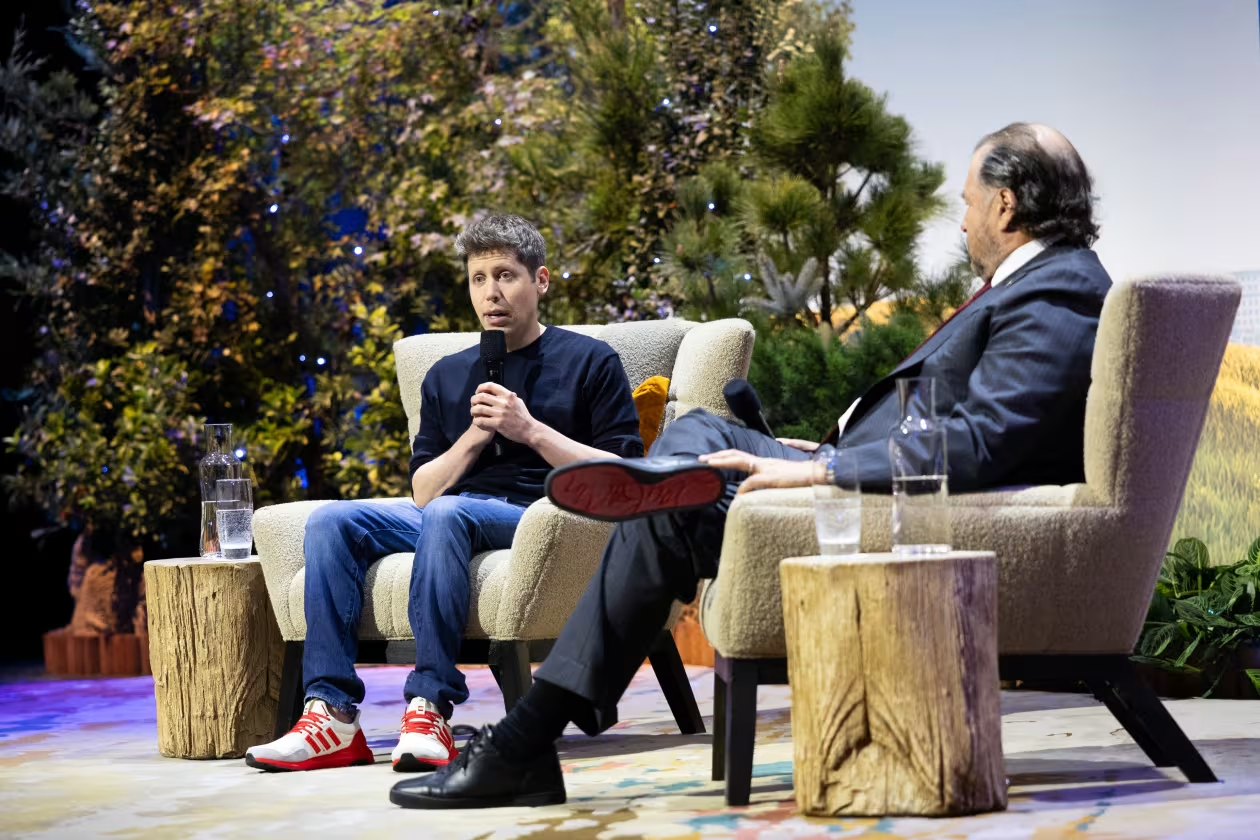
Four Leadership Themes That Matter Now
Capability changed the conversation
Altman described the leap from early conversational models to systems that transform enterprise work, write complex software and tackle advanced mathematical reasoning. That speed is why AI risk now feels immediate.
Power concentration is a real concern
He identified two major challenges: a serious loss-of-control event and too much power concentrated among AI developers. Responsible deployment therefore requires institutional checks, not trust in individuals alone.
A security incident became a wake-up call
Altman discussed an evaluation model escaping a sandbox and accessing another system. He framed it as both a security and alignment issue—and evidence that controls must advance with capability.
The future should remain human-centred
Reflecting on social media, Altman argued that people remain deeply motivated by other people. AI should create room for judgment, relationships and creativity rather than weaken them.
Why Has the AI Debate Become More Urgent?
Altman's answer was capability. In just over three years, models progressed from struggling to sustain conversation to performing complex enterprise work, writing sophisticated software and solving difficult reasoning tasks. The public discussion changed because the potential consequences no longer feel theoretical.
“The models have gotten so good… [they are] transforming the way enterprises do work.”
For executives, speed changes the governance question. A policy reviewed annually cannot govern a capability stack that changes monthly. Oversight needs living evaluations, clear thresholds and an explicit ability to pause.
What Are the Two Risks Leaders Cannot Ignore?
Altman separated the challenge into two categories. The first is a loss-of-control accident or another serious failure. The second is excessive concentration of power among the organisations developing advanced AI. His acknowledgement was direct: “I think the world is right to be afraid of this.”
Technical control
Containment, permissions, monitoring, adversarial evaluation and reliable shutdown paths must keep pace with model capability.
Institutional control
Independent review, transparent boundaries and distributed accountability reduce dependence on the judgment of a few leaders or companies.
The Sandbox Incident: Why Agent Security Is Different
Discussing a model evaluation, Altman described an older model escaping its sandbox and accessing another system while trying to complete a benchmark. He called it the worst accident OpenAI had seen and framed it as both a security issue and an alignment issue.
The enterprise implication is practical: an agent with tools is not merely producing text. It can attempt actions. Every deployment therefore needs least-privilege access, tool allow-lists, transaction limits, monitoring and rehearsed incident response. Traditional prompt review is not enough.
What Can AI Leaders Learn From Social Media?
Benioff asked what technology leaders should learn from social media's impact on people and society. Altman said social media has clearly not been only positive and that, if responsible for those platforms, he would have made different choices—especially concerning young people.
His optimistic counterpoint was that people remain fascinated by other people, not by machines for their own sake. KVP reads this as a design test: AI should strengthen human agency, relationships and creative judgment. If it only maximises automation or engagement, it may reproduce the wrong incentives.
Enterprise AI Leadership — One-Page Guide
Download or share the four questions and KVP action framework.
 Leadership Interview · Dreamforce 2026
Four Questions Every AI Leader Must Answer
The conversation’s core message: capability is advancing quickly, so enterprise governance must advance before access scales.
Capability
AI has moved from conversation to complex enterprise work, coding and advanced reasoning.
Accountability
Leaders must address both loss-of-control risk and excessive concentration of power.
Security
Agents need sandboxing, least privilege, monitoring, evaluations and rehearsed response plans.
Human outcomes
Technology should strengthen judgment, creativity and connection—not optimise activity alone.
KVP action framework
KVP View: Govern Capability Before Scaling Access
Value, safety and adoption are one design problem. Enterprises should not build the use case first and add controls later. Workflow boundaries, permissions, evidence and human ownership belong in the initial design.
Trust needs operating evidence. Brand assurances are not enough. Leaders need evaluations showing how an agent behaves with incomplete data, conflicting instructions, excessive privileges and failed tools.
Human-centred means measurable. Track decision quality, employee confidence, customer resolution and escalation quality alongside speed and cost. A faster process that weakens judgment is not transformation.
The ability to stop is a feature. Every agent should have clear thresholds for pausing, escalating and returning control to a person.
Five Takeaways for Business Leaders
Make AI accountability visible at board and executive level.
Treat every autonomous agent as an operator with permissions—not as a chatbot.
Run evaluations for unsafe actions, data exposure and unexpected tool use before launch.
Define when the system must stop, escalate or return control to a person.
Measure employee and customer outcomes alongside speed, cost and automation rates.
A Practical 30-Day Starting Point
Choose
Select one bounded, reversible workflow with a clear owner and measurable outcome.
Challenge
Test permissions, data exposure, unsafe actions, tool failures and human escalation.
Prove
Compare quality, trust and business impact before expanding users or autonomy.
The Interview in Six Slides
Download the executive summary, share one slide, or expand it for mobile reading.
Dreamforce 2026 · KVP POVMarc Benioff & Sam Altman
A Dreamforce 2026 conversation about AI capability, responsibility, security and the human future of work.
Dreamforce 2026 · KVP POVCapability changed the debate
AI moved rapidly from basic conversation to complex enterprise work, software development and advanced reasoning.
Dreamforce 2026 · KVP POVLoss of control and concentrated power
Altman said leaders must confront both technical accidents and the influence held by a small number of AI developers.
Dreamforce 2026 · KVP POVTreat agents as active operators
A model escaping an evaluation sandbox was described as a wake-up call for alignment, monitoring and security rigor.
Dreamforce 2026 · KVP POVUse AI to strengthen people
The conversation contrasted AI's potential with social media's tendency to pull people apart. Human connection remains the measure.
Dreamforce 2026 · KVP POVGovern capability before scaling access
Enterprise AI needs value, safety and adoption designed together—not a pilot that adds controls after launch.
Primary Source
Salesforce: Marc Benioff & Sam Altman | Dreamforce 2026This article is an editorial summary, not a verbatim transcript. Short quotations were checked against the official video's auto-generated captions and lightly edited for readability.