
Quick Answer
Tender Intelligence for Installation & Commissioning Contractors: objective and purpose
MEP, HVAC, fire-protection, solar and substation installation contractors depend on workable handover dates and testing conditions. Civil delays, unclear utilities or late acceptance signoffs can turn a promising installation contract into idle-time and working-capital exposure.
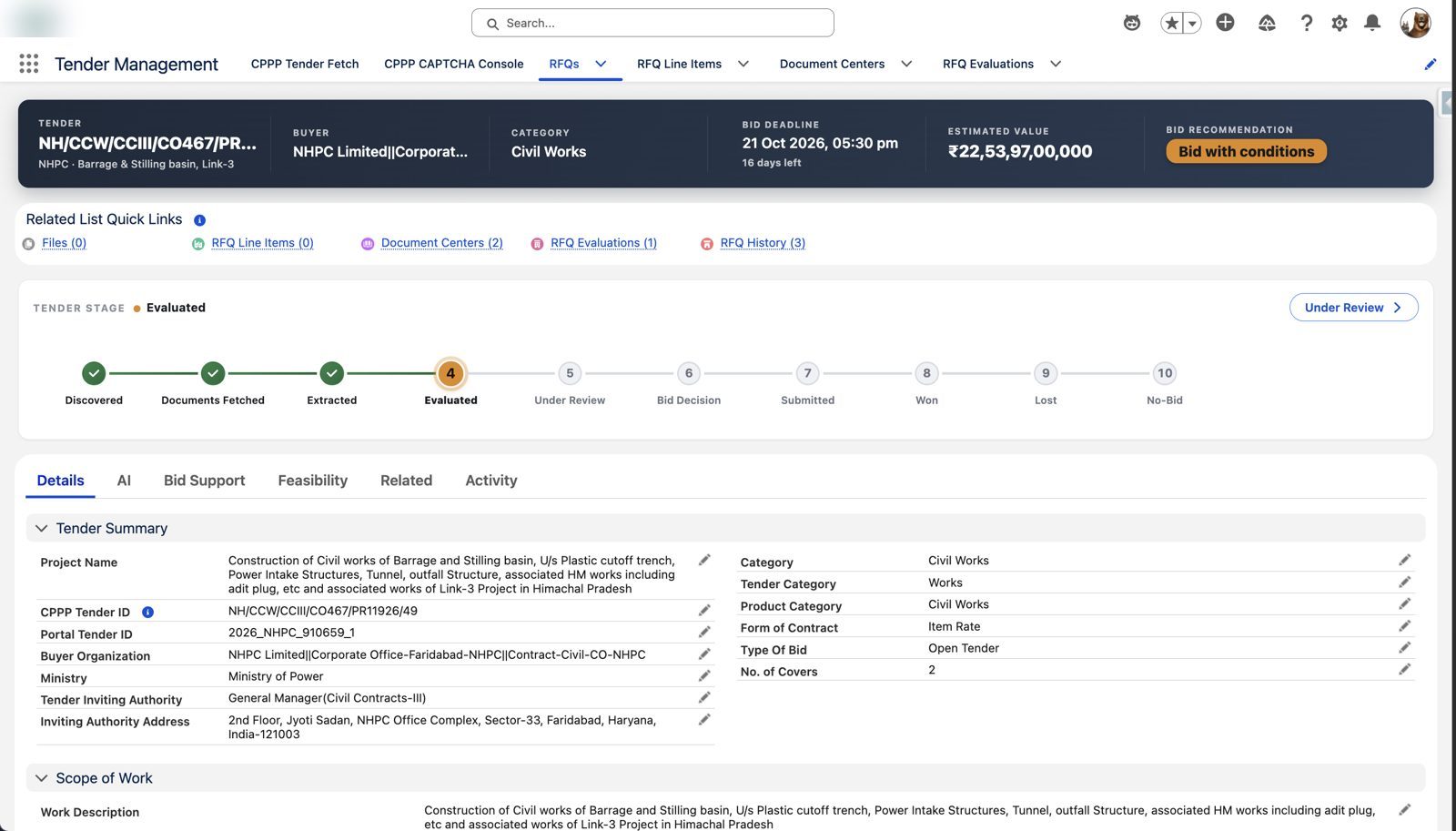
KVP’s asset surfaces site prerequisites, milestone dependencies, testing terms and commercial exposure before project engineers commit to detailed estimates. It helps the team qualify installation, testing and commissioning (ITC) packages and assemble a disciplined bid plan in Salesforce.
Operational and commercial impact
The conventional workflows are illustrative scenarios from KVP’s supplied drafts, not measured industry benchmarks. Timings, throughput and capacity improvements are proposed pilot targets, not verified results or guarantees. Document quality, volume, portal access, configuration and human review affect actual performance. No tender award or win-rate improvement is claimed.
| Critical metric | Illustrative conventional workflow | With Agentforce: intended capability / pilot target |
|---|---|---|
| Site & milestone review | Illustrative 4–6 days reviewing specifications, drawings and interface matrices. | Target under 30 minutes of processing for initial site-readiness and testing requirement extraction. |
| Cash-flow exposure | Delayed acceptance can extend retention and bank guarantees. | Make mobilisation advances, payment milestones and retention release terms visible early. |
| Dependency risk | Civil-readiness and work-front constraints are unclear during bidding. | Extract employer obligations, access dates and handover conditions for project-manager review. |
| Testing compliance | Witness inspections or acceptance requirements surface late. | Identify stated Factory Acceptance Test (FAT) and Site Acceptance Test (SAT) milestones; verify completeness against the source. |
Three value pillars for your bid team
1. Defend project engineering capacity and cash flow
Focus site managers on staging, dependencies and subcontractor pricing rather than repeated document searches.
- Civil prerequisites, site access and utilities needed to execute the scope.
- Inspection agencies, FAT/SAT criteria, performance trials and handover obligations.
- Retention, guarantee extensions and liquidated damages linked to commissioning milestones.
2. Ground execution assumptions in source documents
An unstated site condition should become a clarification—not an implicit commitment.
- Link milestone dates, warranty obligations and installation standards to source pages.
- Flag missing crane/lifting provisions, storage areas and commissioning power connections.
- Review interface assumptions with the employer before final pricing.
3. Connect the approved bid to an estimation workspace
Configure discipline-specific tasks and deadlines, while project leads retain acceptance responsibility.
- Allocate packages to electrical, mechanical, safety and procurement teams.
- Track mandatory site visits, pre-bid meetings, certificates and query deadlines.
- Centralise detected changes to specifications, milestones and schedule extensions.
Implementation architecture: portal to proposal
- 01
Permitted portal intake
Scope buyer organisations, categories, access permissions and polling frequency. Confirm GeM separately; do not bypass portal access restrictions or CAPTCHA requirements.
- 02
Document evidence and Salesforce records
Retain tender PDFs and page references; extract scope, dates and qualification requirements into the opportunity/RFQ record. Test scans, annexures and drawing interpretation with reviewers.
- 03
Configured qualification and approval
Map technical fit, complexity, execution risk, commercial risk, schedule risk, eligibility risk and competitiveness to your business capabilities. Keep unknowns visible; bid leaders approve the recommendation.
- 04
Proposal preparation and team ownership
Configure tasks, quote requests, finance checks, pre-bid queries and draft proposal inputs. Confirm BOM, inventory, ERP or partner-system connections rather than assuming they exist.
- 05
Corrigenda, readiness and human submission
Track detected amendments, route changes for review and retain a dated readiness checklist. Authorised people sign declarations, approve pricing and submit on the official portal.
The demonstrated customer build covers CPPP discovery. GeM and other portal integrations, polling frequency and permitted access are confirmed separately. These five pages describe industry-specific configurations of the same asset—not five independently verified deployments. AI extraction and recommendations require source checking; authorised people approve bid/no-bid, pricing and final submission. Agentforce licensing, usage costs and integrations are confirmed during scoping.
See the underlying asset walkthroughKVP view: qualify before committing scarce capacity
Treat site readiness as a bid qualification gate, not an execution surprise. Pilot on a package with known interface issues, verify the extracted dependency matrix and test whether finance can see retention and guarantee exposure before approval.
Start with a measured pilot
Select representative historical tenders, establish a human-reviewed baseline, configure capability and commercial gates, and agree ownership across sales, operations and finance. Track extraction errors, citation correctness, qualification time, reviewer effort and costs. Validate changes before broad rollout; keep tender awards separate from qualification metrics.
Frequently asked questions
How does tender intelligence help Installation & Commissioning Contractors?
KVP’s asset surfaces site prerequisites, milestone dependencies, testing terms and commercial exposure before project engineers commit to detailed estimates. It helps the team qualify installation, testing and commissioning (ITC) packages and assemble a disciplined bid plan in Salesforce.
Are these processing times and capacity gains verified results?
The conventional workflows are illustrative scenarios from KVP’s supplied drafts, not measured industry benchmarks. Timings, throughput and capacity improvements are proposed pilot targets, not verified results or guarantees. Document quality, volume, portal access, configuration and human review affect actual performance. No tender award or win-rate improvement is claimed.
Does this include GeM and CPPP coverage?
The demonstrated build covers CPPP. GeM, other portals, access permissions and monitoring frequency are scoped and validated separately; continuous or universal discovery coverage is not promised.
Does Agentforce decide or submit the bid automatically?
No. The agent proposes an evidence-linked qualification and prepares tasks and proposal inputs. Authorised people validate source clauses, approve the bid and pricing, and make the final portal submission.
How are missing information and AI errors handled?
Source citations and an unconfirmed-items register support review. Reviewers check citation correctness, document extraction and ambiguous clauses; no zero-hallucination, perfect accuracy or regulatory-compliance guarantee is made.
How do we start and what does it cost?
Choose a representative tender category, validate extraction against human-reviewed dossiers and configure qualification rules and ownership. KVP scopes portal access, Salesforce setup, integrations, Agentforce licensing and usage costs before a pilot.
Industry solutions
Sources and scope
Adapted from KVP’s supplied industry drafts and the existing asset specification. Figures are design targets, not independently measured customer results.